
Empathy maps are tools to understand the thoughts and feelings of customers at different stages of their journey and experience, and at different points of product usage and engagement with a company. Empathy mapping is a useful exercise to enhance your customer research and inform development of more effective customer engagement and marketing strategies.
How does an empathy map work?
An empathy map captures different aspects of the user experience to better understand customers. By mapping out your customer's mindset throughout their journey with your business and product, you can uncover valuable information and insight surrounding customer needs and wants. This data is useful for multiple purposes, in particular for customer marketing strategy development as well as product design and persona and messaging development, among others.
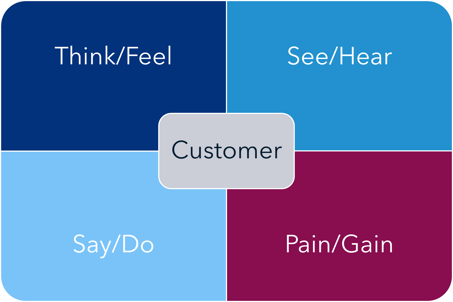
- The Think/Feel quadrant captures what the user is thinking or feeling during their experience with the product or service. This includes their beliefs, values, emotions, goals, and aspirations.
- The See/Hear quadrant captures what the user sees or hears during their experience with the product or service. This includes anything within the product experience such as any visuals, images, and videos they encounter, as well as any audio they hear such as music or sound effects. This also includes what they hear or see externally as related to the product experience.
- The Say/Do quadrant captures what the user says or does during their experience with the product or service, or during a particular journey stage. This includes any verbal feedback they provide as well as any actions they take while using the product or service.
- The Pain/Gain quadrant captures what pains and gains users experience while using your product or service. This includes any frustrations they may have as well as any rewards they receive from using it.
Empathy Mapping in Practice
To bring this to life, see the illustrative example below which is for a business user of a fictitious process automation software tool.
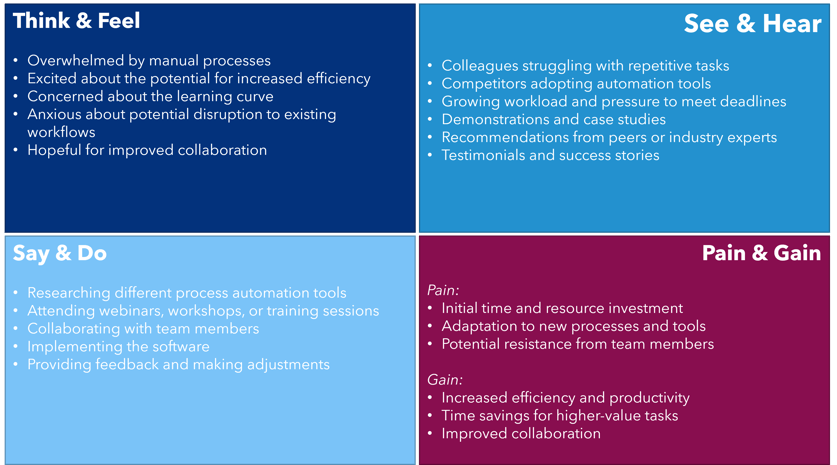
Once you've completed your own empathy map, use the outputs to refine how and where you dig into your customer data, as well as inspire ideas for messaging, content, and initiatives to support your customer marketing strategies.
In addition, beyond helping you to better understand the thoughts and feelings of customers at various stages of the customer journey and different points of product usage and engagement, empathy mapping is a useful exercise to drive collaboration and shared understanding with your colleagues from functions across the business.