
The annual employee engagement survey (EES) scores are out, and it’s no surprise that sales teams rank at the bottom — as always. Sales leaders and their HR business partners have come to expect this, but it doesn’t have to be that way. This post addresses the question, “How can we improve employee engagement results in sales?” by identifying the seven challenges to sales employee engagement and proposing sales-specific solutions.
Why Should Sales Leaders Care about EES?
Revenue per quarter doesn't depend on EES. It more so presents as a problem in the long term. The goal is to enable sellers to achieve their target not only in the current year but also in subsequent ones.
- Low engagement is a leading indicator of a very expensive problem, sales turnover.
When engagement scores dip, the cost of recruiting, hiring ,and onboarding will soon rise. Open territories kill your chances of yearly success.
- Customers are directly influenced by the attitudes of their sellers.
Research shows that an employee's attitude toward their job's importance, and the company, has the greatest impact on loyalty and customer service, compare to all other employee factors combined.
Top Barriers To Sales Engagement
The usual solutions to low employee engagement scores don’t always apply to sales teams. Team-building exercises and reward systems are frequently cited as panaceas, but these programs don’t work well for field sales people who are remote from their managers and peers. Their performance is already rewarded by a high-leverage compensation plan.
These are the seven unique barriers to sales employee engagement:
- Isolation
- Split allegiance
- Silos
- Income inequity
- Rejection
- Job insecurity
- Work-life imbalance
Guidance and Solutions
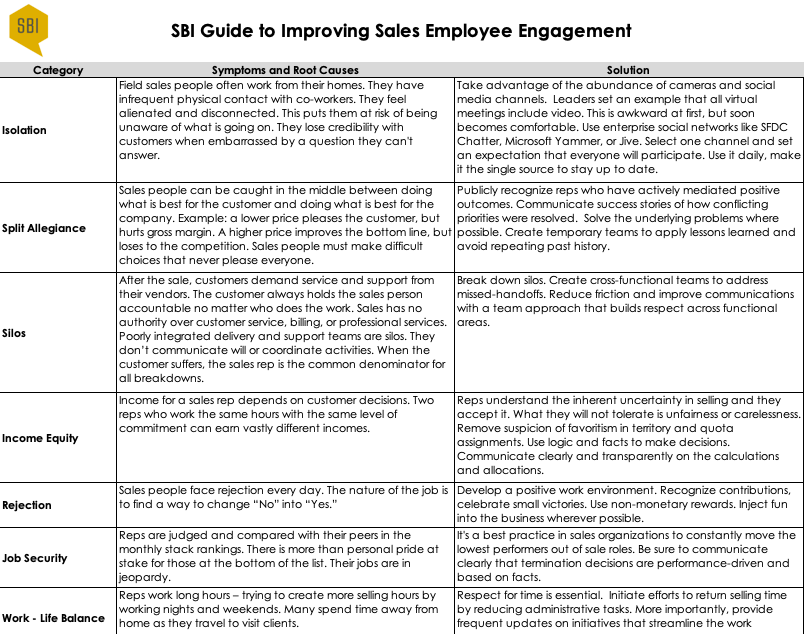
Solutions exist for each of challenge encountered by sales teams. Here, we provide three examples, and the full guide below offers insights into all seven barriers.
- Isolation
Symptoms and root causes: Field sellers often work from their homes, with infrequent physical contact with coworkers. Often times, they feel alienated and disconnected, putting them at risk of being unaware of what is going on. They can then lose credibility when they can't answer a question a customer asks.
Solution: Take advantage of the abundance of virtual channels. Leaders should set an example that all virtual meetings include video. Use enterprise social networks such Salesforce.com's Chatter, Microsoft's Yammer, etc. Select one channel and set an expectation that everyone will participate. Use it daily and make it the single source to stay up to date.
- Split Allegiance
Symptoms and root causes: Sales people can be caught in the middle between doing what is best for the customer and the company. For example, a lower price pleases the customer, but it hurts gross margin. A higher price improves the bottom line, but risks losing out to competition. Sales people must make difficult choices that never please everyone.
Solution: Publicly recognize sellers who have actively mediated positive outcomes. Communicate success stories of how conflicting priorities were resolved. Solve the underlying problems where possible. Create temporary teams to apply lessons learned and avoid repeating past history.
- Silos
Symptoms and root causes: After the sale, customers demand service and support from their vendors. The customer always holds the seller accountable no matter who does the work. Sales has no authority over customer service, billing, or professional services. Poorly integrated sales, delivery, and support teams are silos. They don’t communicate well or coordinate activities. When the customer suffers, the seller is the common denominator for all breakdowns.
Solution: Sponsor cross-functional team projects to address missed hand-offs. Reduce friction and improve communications with a team approach that builds respect across functional areas. Engage sellers in project teams that knock down barriers and fix broken connections. Don’t let distance be an obstacle. Use virtual project meetings to engage remote field sales participants.
Take Action Today
Employee engagement surveys set an expectation that leadership cares. When your sales team participates in a survey, they presume that action will result. Employee engagement consultants have uncovered this interconnected dynamic, noting that organizations that survey their workforce without acting on the feedback negatively impact engagement scores. Don’t focus on the scores; focus on taking action to improve them.
The solutions in this guide will enable you to look forward to the next EES. Your engagement scores will be higher than ever and turnover rates will improve. Customer satisfaction will move upward, and you’ll increase your chances at making the number.