
For many commercial teams, 2023 felt like a tipping point where typical prospecting approaches stopped delivering typical results. More risk adverse buyers meant sellers, sales development representatives (SDRs), and marketing teams could do all the right activities, but it felt like their work generated fewer qualified opportunities. Even worse, the opportunities generated were less predictable, often failing late in the sales cycle.
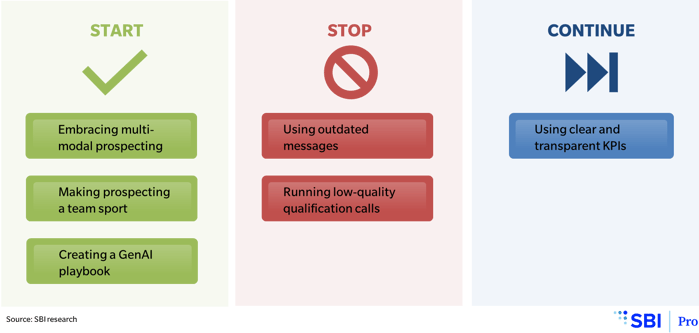
Buyer reluctance and lost deals are not new challenges. Commercial teams are used to dealing with them, and they know the playbook: Refine ideal customer profiles (ICPs), update value messages, and ensure those messages are seen via coordinated prospecting cadences. While these actions are still necessary, in many cases they’re no longer enough. Today, getting buyers’ attention and qualifying high-probability opportunities require leaders to rethink how their teams approach prospecting. To help with these journey, the figure below shows three practices sales teams should adopt, two to abandon, and one to maintain to drive prospecting excellence in 2024.
Start
- Embracing multi-modal prospecting. Getting buyers’ attention and building pipeline requires rethinking typical prospecting cadences. Multi-modal prospecting expands what sales teams know about coordinating outreach across channels (e.g., email, voice, and social media) to focus on different modes of communication (e.g., written, spoken, and video). Start by adapting your prospecting calendar to specify the number of voice, video, and written outreaches sellers should make across channels each week. This takes advantage of different modes of communication even within a single channel to get buyers' attention. For instance, a well-produced video email can convey personality and build trust in ways that text cannot. However, this method lacks the quick readability a well-crafted written message provides.
- Making prospecting a team sport. A notable trend in 2023 involved more senior stakeholders becoming involved late in the sales process, which often delayed or jeopardized deals. Too often sales teams overinflated the quality of their pipelines, not expecting the buyer’s CFO or CEO to get involved in the final stretch. To combat this, successful sales teams are treating pipeline quality like a team sport. Instead of waiting until late in the sales cycle for buyers to bring in their CFOs, CEOs, and/or CIOs, suppliers are looping in their own company’s executives early to smooth the water, so to speak, by having them send messages to their peers in the buying organization. For example, arming the sales organization’s CFO with a short 30-60 second video script to send to a prospective CFO can preempt potential issues. Monitoring whether the message is viewed also serves as a key indicator of deal quality. For this approach to be successful, its vital that sales teams make it easy for the internal executives to participate, both in initial outreach and any necessary follow-ups.
- Creating a generative AI playbook. In 2023, generative AI (ChatGPT, Gemini, Claude, etc.) emerged as a key tool for prospecting efforts. However, commercial teams either overestimate ChatGPT and other tools, thinking they can completely automate efforts, or dismissing them and treating the technology just like another tool. The truth is somewhere in the middle; while generative AI is not yet advanced enough to automate prospecting, given issues such as hallucinations, i.e., incorrect information, and meaningless filler content, it can still significantly enhance prospecting efforts in ways that other tools cannot. Effective use of generative AI involves augmenting the team's expertise, especially with summarizing volumes of information about the industry, company, and stakeholder and crafting messages tailored to specific roles and industries. Sales leaders should begin consolidating their teams' experiences with generative AI over the course of 2023 for the purpose of creating a generative AI playbook. Having such an asset will provide sellers with guardrails and guidance on the best way to use the available tools.
Stop
- Using outdated messages. In 2024, commercial teams need to reset their outreach strategies. How buyers make purchases and who is involved are radically different than they were even 2-3 years ago. As a result, many commercial teams are still sending generic messages that are no longer aligned to the right stakeholders, their needs, and their most updated methods of buying. Sales and marketing leaders must collaboratively reset their understanding of who is involved in the buying group, what those members care about most, and how their solutions uniquely address these needs, distinguishing themselves from the competition.
- Running low-quality qualification calls. The advent of high-quality data, advanced analytics, and AI has paradoxically introduced a new challenge for prospecting efforts: Enterprising SDRs can now fake expertise up front. If buyers encounter standard talk tracks during initial calls, especially after receiving compelling email or video messages, it can lead to disappointment and erode trust in the sales process, which may deter them from pursing business with the company in the future. Addressing this requires a concerted effort from frontline managers and sales enablement teams. Managers should be using conversational analytics to scale call review and personalized coaching, supplementing generative AI tools to create individualized learning plans for deeper buyer understanding.
Continue
- Using clear and transparent KPIs. Finally, it’s important to continue tracking and providing visibility on core pipeline metrics, e.g., number of opportunities in the funnel, lead conversion rates, customer acquisition costs, pipeline velocity, etc. Highlight these metrics in a unified dashboard that shows current state against monthly, quarterly, and annual goals to hold the entire commercial organization accountable for what it takes to succeed. If your company also tracks prospecting activities, show these on a second dashboard, so individuals can see how their efforts compare to their peers.
Buyer behavior has changed, and prospecting strategies need to keep up. By ensuring teams are taking advantage of new technologies and methods of outreach, sales leaders can help their teams break through the noise and meet growth goals in 2024.