
A buyer journey map is a foundational part of any sales process. It highlights how buyers make decisions, what information they seek, what concerns they may have, and how they move through the stages of a purchase decision. When done well and used correctly, it functions as a conceptual framework and a tool that allows sales teams to thoroughly understand their customers and modify their approach based on that understanding.
Many companies have yet to truly document their buyer journey. Among those that have, they don’t refresh it often or find it to be an academic exercise that doesn't get much use by teams as they pursue deals. This is because many focus solely on the sales process rather than looking at the buyer’s point of view. Others might not put a big enough emphasis on the importance of using the buyer journey map in the sales process.
This article shares a series of common oversights and best practices that we have learned across more than a decade working on buyer journey maps with our clients. Commercial leadership teams can use them to build a buyer journey map that is widely used within their organizations and impactful as sellers pursue deals. We organize them into three main categories: Process Alignment & Maintenance, Research & Insight Gathering, and Personalization & Buyer-Centric Thinking.
Process Alignment & Maintenance
1. Don’t assume the buyer journey and sales process are separate – align both to ensure sellers are in sync with buyers through the deal.
Only 26% of sellers report that they have a structured, clearly defined sales process. Part of the reason for this in many cases is that their process is not sufficiently buyer-centric. Companies often design their sales process and buyer journey in isolation. For the former, they focus on internal goals, metrics, and timelines rather than considering the buyer’s perspective. They often try to then add the buyer journey to this existing strategy.
Our experience is that it should be the opposite. The buyers’ journey is the foundation of thoughts, questions, and actions the buyer may take throughout each stage of the journey. As such it forms a starting point for the sales process. The sales process then provides a reference for the seller and organizational activities required to help the buyer advance through their buying process. When they are not closely linked, the selling team and buying team will operate at odds with one another, misunderstand and feel disconnected from each other, and at best unnecessarily extend cycle times.
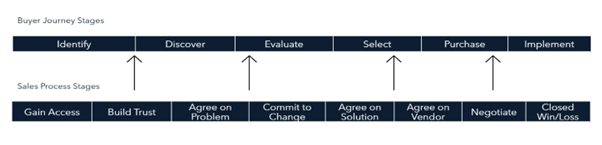
It’s important to note that while they work together, the stages of the buyer journey and sales process don’t need to align 1:1. Often, one will have more stages, or timing may not align. For example, “Build Trust” in the sales process stages may be happening between the “Identify” and “Discover” stages of the buyer journey (see example below). By visually showing how and where the stages coincide with each other, sellers can better pinpoint where the buyer is on their journey and what they may need to be doing to help them.
Buyer Journey and Sales Process Stage Alignment
2. Don’t assume the buyer journey is linear - recognize that it is a winding path with movements forward and backward.
We often find that companies think about the buyers’ journey as a linear process — first they do this, then they do that. But individuals’ decision-making is hardly linear. This becomes even more complex within an organization with multiple individuals involved. When creating your buyer journey map, keep in mind that buyers today jump forward and backward, skip steps, and repeat stages (see the chart below). Trying to fit a buyer into your set sales process may become frustrating for the buyer and lead to a lost opportunity.
What the Buyer Journey Really Looks Like
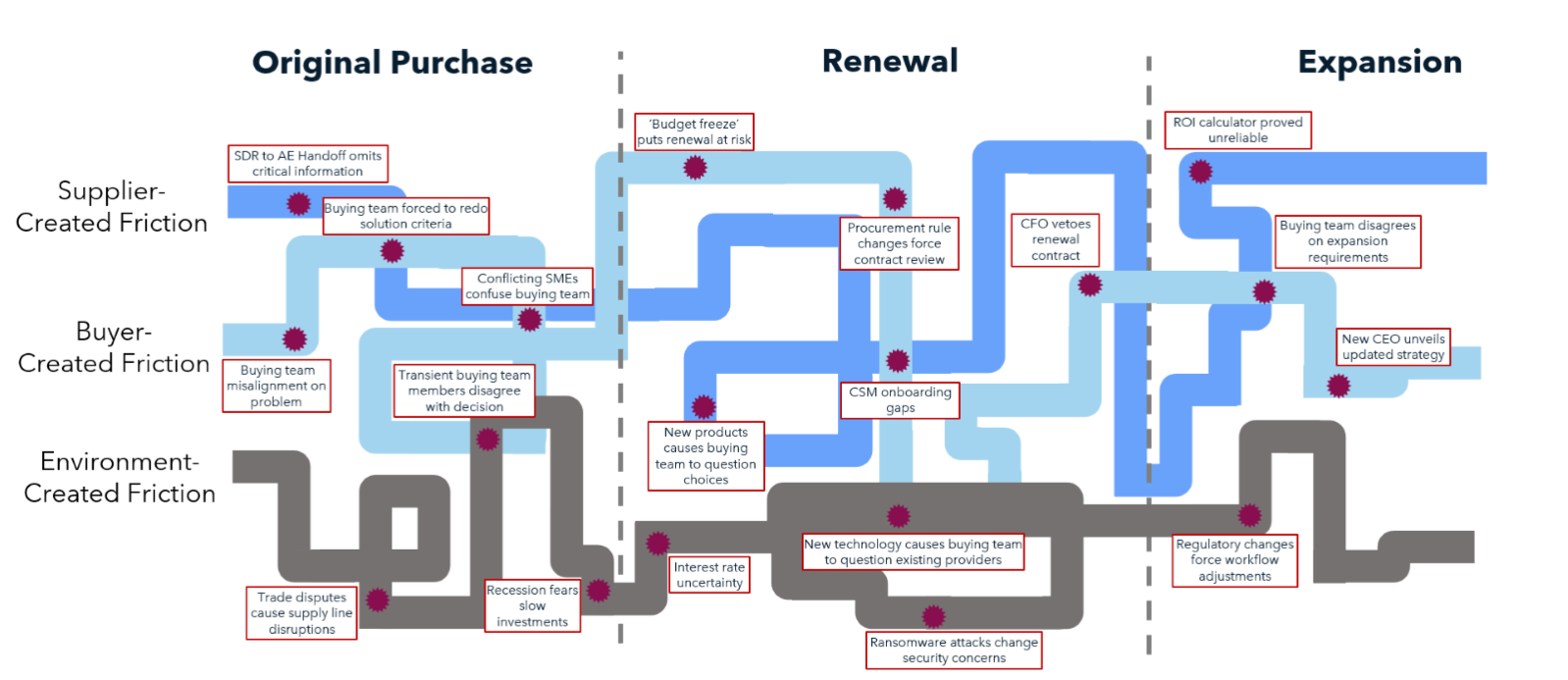
A good buyer journey map recognizes that some things aren’t stage-specific. In SBI’s buyer-journey-map-template, we include a separate section for “Always-On Actions Across the Buyer Journey”. This describes what actions commonly repeat throughout the journey. For example, “building consensus with peers and decision-makers". While perhaps in the past this happened at a specific point of the buying process, it is now more-or-less an always-on action. By gaining consensus through each stage, buyers try to avoid backtracking in the journey, while at the same time they often find a need to go back and re-gain consensus as conditions change.
Research and Insight Gathering
3. Don’t assume you intuitively know the buyer journey - conduct buyer interviews to outline the process from initial thinking to post-purchase plans.
A common mistake commercial leaders make is thinking they have all the information they need on-hand to create a buyer journey map. Often, they rely on sellers’ documentation and articulation of the buyer journey, which can give a false read. Or they may assume they can use their informed assumptions about what the buyer is doing, or rely on their recollection of past sales experiences. However, no matter how long someone has been selling, they will always have a limited understanding of what is happening on the buyer side of the deal without direct input from buyers. Markets evolve, and buyers think differently than sellers.
This is why we view it as essential to conduct interviews with buyers about their buying journey. By conducting interviews, you hear first-hand how buyers move through the buyer journey. Interviews can also relay what pain points they may have, criteria they prioritize, emotional drivers motivate them, and hesitations hold them back.
Additionally, interviews can identify subtle differences in how various buyer personas approach each stage. For example, some buyers may skip the "evaluation" stage if recommended by a trusted colleague, while others may spend longer periods of time comparing solutions. By collecting perspectives, teams can gain important information and create an accurate representation of what the buyer is experiencing.
4. Don't go into customer interviews with too narrowly-focused or broad questions – do create interview guides that illuminate the buyers' journey.
There is a disconnect between the questions commercial leaders bring into customer interviews and the information they hope to get out of them. By asking questions that are either too narrowly-focused or too broad, the feedback from the buyer may be incomplete or irrelevant. Some questions may be too narrow regarding why they bought or why they didn’t, for example. This does little to help understand the journey the buyer went through.
That’s why structured interview guides are essential. A good interview guide has open-ended questions for each stage of the buyer's journey. These questions help uncover motivators, friction points, and information that the buyer needs to progress. They also reveal emotional responses. Instead of asking questions such as, “Why didn’t you buy?”, “Who did you buy from instead?" or other typical win-loss type topics, ask questions like
- “What prompted you to begin searching for a solution?” during the “identify” stage, or
- “What hesitations do you have about this solution?” during the "evaluate" or "select" stage.
Tailoring the questions to not only the persona type, but also the buyer stages helps commercial leaders better understand the journey the buyer goes through.
5. Don’t go too long a period without revisiting your buyer journey map – do have triggers to indicate when to update it.
Buyers and the market are constantly evolving, which makes the buyer journey evolve too. Companies often don’t recognize how much their buyers’ journey has changed since they last updated their buyer journey map, which could be years ago. They may also neglect the buyer journey map, letting it go stale without anyone noticing. Without regular updates, your journey map will become outdated, irrelevant, and disconnected from how buyers operate today.
To prevent this, establish specific internal and external triggers for updating the buyer journey map. These triggers might include:
- Launching a new product
- Entering a new market
- Receiving a critical mass of negative buyer feedback
- Noticing a significant drop in conversion rates
- Observing changes in buying behavior
- Observing changes in the profile of customers who are converting
- Experiencing significant change in external market conditions
Regularly reviewing your buyer journey map ensures that your teams stay up to date while continuously aligning with the current buyers' current needs.
Personalization & Buyer-Centric Thinking
6. Don’t use a universal approach for all buyers – do incorporate buyer personas to personalize the journey.
Understanding what type of individual you are speaking with can help you tailor the sales process around their specific position, pain points, goals, and buying behaviors. For example, talking with a CEO requires a completely different approach than when engaging with a CFO or CMO.
The persona-based-buyer-journey-template helps to personalize the broader buyer journey to specific members of the buying decision team.
Buyer Persona Template
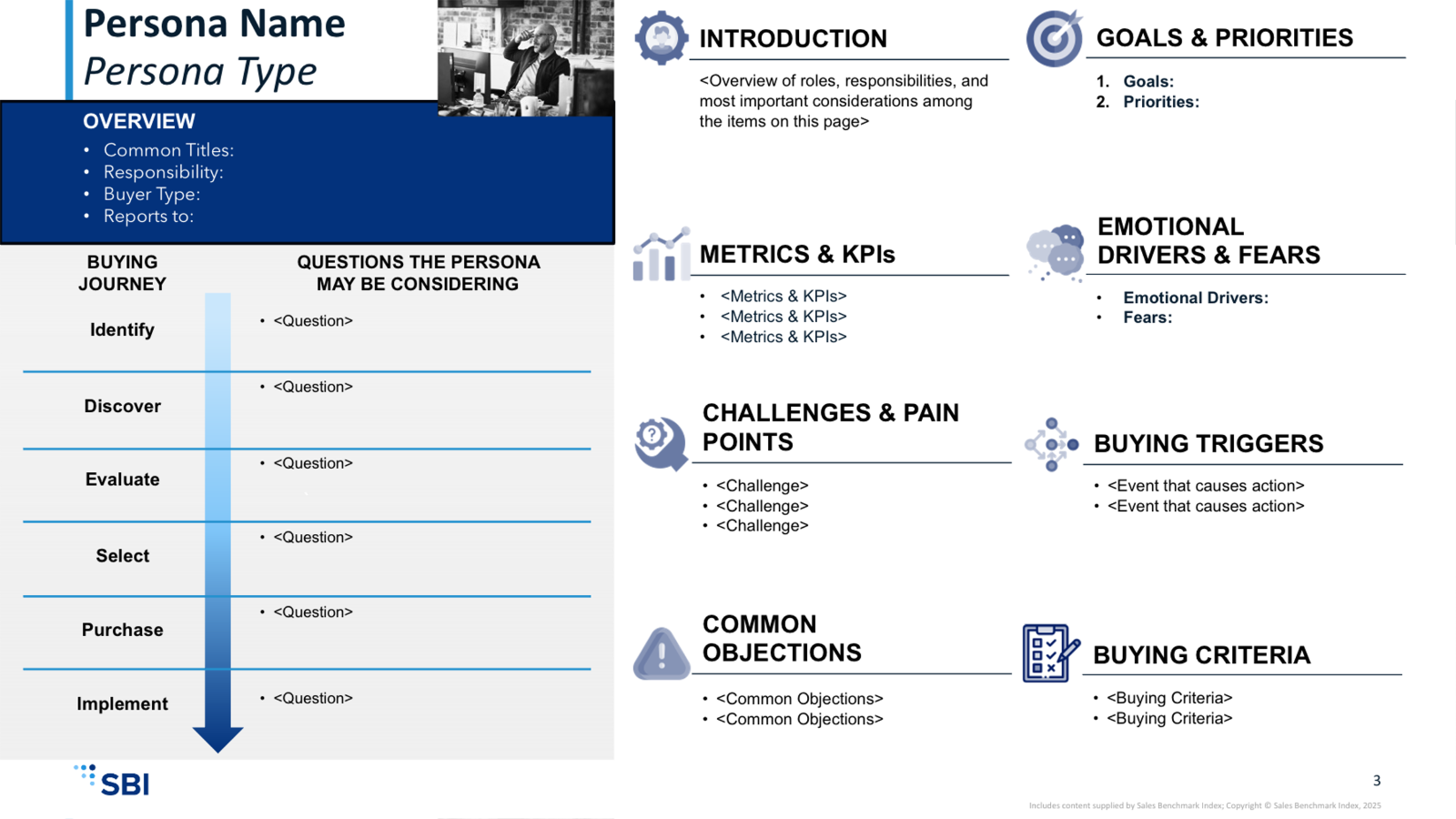
Incorporating personas into your buyer journey mapping exercise enables your team to tailor messaging, demos, and content to each role. For instance, while a CMO may want brand and buyer engagement, a CFO will likely want to understand ROI and cost savings. Ultimately, this creates a more relevant and persuasive delivery approach.
7. Don’t assume the journey is universal for all companies – do evaluate the need to vary it by geography, vertical, or size of the company.
Oversimplifying the buyers’ journey can make it irrelevant to buyers who may not fit one version of the buyer journey. Buyers can vary by geography, industry, company size, or department. They each have different priorities, buying behaviors, and decision-making processes. Creating a one-size-fits-all buyer journey ignores these differences and potentially risks alienating the buyer who doesn’t align with the approach.
For example, larger companies may require approval and involvement of multiple stakeholders in the evaluation and selection stage. Smaller companies may have the business owner making those decisions solo. A software company might find that buyers in North America prefer self-service demos and online research. In contrast, buyers in Europe may prefer to engage early with a local rep. By creating multiple journey maps that reflect variations, commercial teams can deliver more relevant messaging, support, and solutions, which improves the buyer experience.
There is a sweet spot in finding this by asking questions about their priorities, criteria, and metrics. Some questions may include: “What would success look like for your team with this solution?”, “What features or capabilities are must-haves for you?”, or “How do you measure ROI or success for a purchase like this?”
8. Don’t think of information needs across the buyer journey as “keeping people warm” – do think of it as a way of solving stage-specific friction points.
Each stage of a buyer's journey brings new questions and doubts. This makes it critical that sellers provide them with timely information that addresses those concerns. In many cases, however, teams “over-correct”, assuming that more information is better. This makes it challenging for buying teams to find what they are looking for.
SBI research in delivering-sales-velocity-in-todays-market has identified four “approaches” that sellers commonly take in their efforts to help buyers make faster and more favorable purchase decisions. One of those approaches, which we refer to as “provoking”, engages buyers with ideas. It keeps them interested, on the positive side, but it also often disrupts or confuses their journey. As a result, buyers stay in the sales cycle 22% longer when sellers lead with the “provoking” approach.
Sellers instead need to be sure they are providing only the essential information at the right time. One way to do this is to understand the specific buyer friction points the buying group is facing in the moment. For example, in the "select" stage, buyers may be comparing feedback, contracts, or ease of implementation to other solutions. Therefore, content that includes ROI, references, case studies, pricing and contract terms can be extremely effective.
You can find more details on friction points in our report on easing-buying-friction. When you share useful information, it becomes a powerful tool. It helps the buyer move forward on their journey instead of just filling space.
9. Don’t just add a renew/expand stage to the journey – do understand the buyer’s true renewal and expansion journey.
While some buyer journey maps include a "renew" or "expand" stage following the “implement” stage, this approach can often be overly simplistic and premature. Renewal and expansion are not checkboxes at the end of a journey—they are distinct, nuanced processes that may not follow a linear path themselves.
Buyers considering renewal or expansion often re-engage with earlier stages of the journey, such as “evaluate” or even “discover.” A buyer looking to renew might want to know what has changed since their last purchase. This can lead them to reassess options, explore new features, check competitors, or review ROI metrics. This means they’re not continuing the journey but re-entering it with updated needs and expectations.
Depending on your sales model and customer behavior, it might make more sense to treat renewal and expansion as a separate but connected journey, rather than simply an extension of the original. This renewal/expansion journey might include stages such as "post-sale", "adoption", "expansion", and "renewal", each with its own set of buyer needs, decision points, and friction areas.
The buyer journey map is an essential part of understanding how to form a sales strategy but is often underused and undervalued. By avoiding common misconceptions and implementing these best practices, commercial teams can create a more buyer-centric approach that drives engagement and long-term relationships.