
Proper headcount is critical to making your number.
Many companies size their sales force incorrectly. Specifically, the CEO might project the growth number, leading sales leadership to divide the revenue number by the average quota number. This produces a headcount number. Then you take the headcount number and multiply it by the cost per rep. You use the “all-in” cost-base, commissions, and overhead. This yields a cost of sale typically expressed as a percentage of revenue. This simple analysis is the most common approach to headcount planning in sales organizations, but it carries down-sides.
Below is a quota distribution chart. On the left side vertical axis is the number of reps. On the right side vertical axis are quota numbers expressed as dollars. The red bars from <10% – 99% are the number of sales reps for each range. For example, five sales reps attained between 40% and 49% of the quota. The green bars indicate reps who exceeded quota.
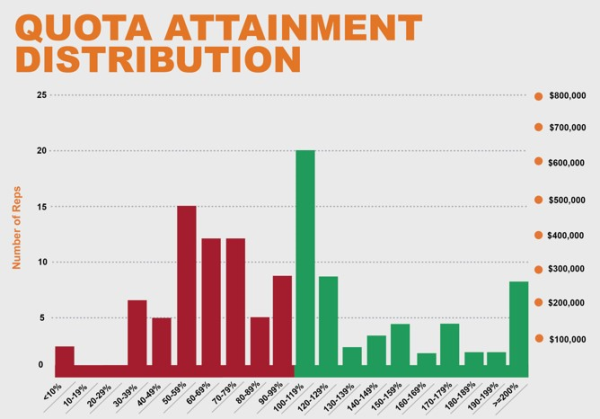
This distribution would challenge anyone, especially CFOs, who will be prompted to cut headcount that they perceive as expensive and underperforming. But open headcount will also cause teams to miss their number.
What's a better way to do this? A top-down approach and a bottoms-up approach.
Top-down: Calculate the territory market potential
This method works best if you employ Hunter sales reps (who hunt new logos). First, using your Ideal Customer Profile, identify the number of opportunities in your market. Then calculate the potential revenue from the market. Do this by looking at the current spend of customers who resemble the ideal opportunities you've identified. This allows you to see the total potential of your market. You can also see the potential of each existing territory. Often, the potential will vary dramatically by rep territory. This is a common cause of unequal rep quota attainment.
The Workload Analysis Calculator will help you run a workload analysis. Use it to identify how many sales reps you need and to achieve a balanced quota.
Bottoms-up: The workload analysis approach
This method works best if you employ Farmer sales reps (who develop existing accounts). Start with your total number of existing target accounts. Have you mapped your ideal customer's Buying Journey? If so, you know how often they want to be called on. Multiply this call frequency by the number of accounts. When you multiply these two numbers you get an annual call volume. This is the total number of rep appointments per year.
Let's apply some math to this. Assume you have 2,000 target customers. You want to call on each one of those accounts once a month. That's 12 x 2000 = 24,000 calls.
Now calculate rep capacity. Based on your experience, how many appointments can your reps handle in a week? Let's say it's 8. Multiply that by the number of working weeks in a year (typically 47). Using those numbers, 47 x 8 = 376 appointments in a year.
24,000 annual calls divided by 376 calls per rep equals about 64 reps. This is an example of a workload analysis, or bottoms-up approach.
When you use these two methods you get a quota distribution curve like this:
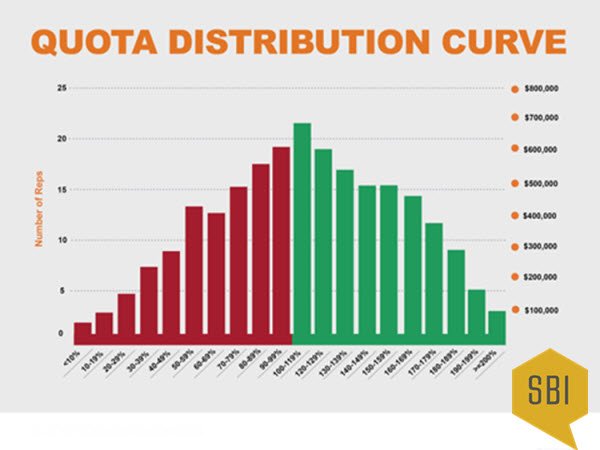
This kind of standard distribution makes CFOs very happy. You've staffed your organization properly to enable you to make the number. You'll produce balanced quota attainment, which is typically in the 60-75% range. Put another way, 38-48 of your 64 reps (60-75%) should make the number.
The Workload Analysis Calculator can help you start running a workload analysis today.