
Organizations face sales productivity concerns as they kick off 2023, with pressure mounting due to buyer uncertainty in a sideways market, a renewed focus on earnings over growth, and owners and shareholders hungry for good news. Facing the background of a tight labor market, companies risk workforce burnout and missed opportunities to capture new markets.
CEOs and their go-to-market leadership teams have labor market pressures on their long list of concerns for the year. Our recent survey of 102 CEOs and go-to-market leaders reveals significant but addressable obstacles that must be contended with to drive sales productivity in 2023. In particular:
- Planned hiring will be insufficient to adequately cover open territories.
- Onboarding is insufficient to rapidly ramp new hires to productivity.
- Identifying sources of employee burnout is necessary for sustained growth.
Navigating these risks requires both tactical and strategic efforts. Here we detail the obstacles to sales productivity emerging from our data, and some straightforward solutions for addressing them
Plans to expand Sales headcount will be insufficient to adequately cover open territories
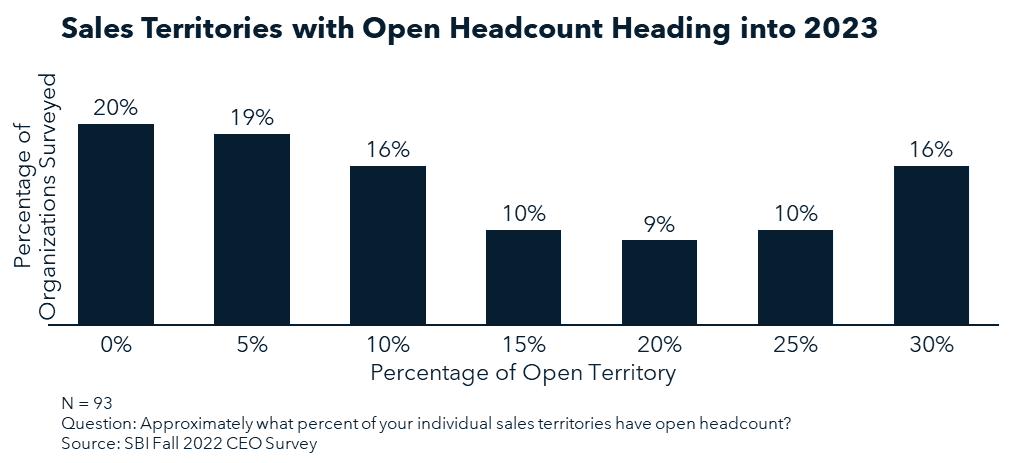
Nearly half of go-to-market leaders in our survey indicate that at least 15% of their territories are uncovered, yet most are planning to either hire 10% or fewer new headcount or none at all in 2023. This means that, on a 1:1 basis, planned hiring will, in most cases, be insufficient to cover current business needs.
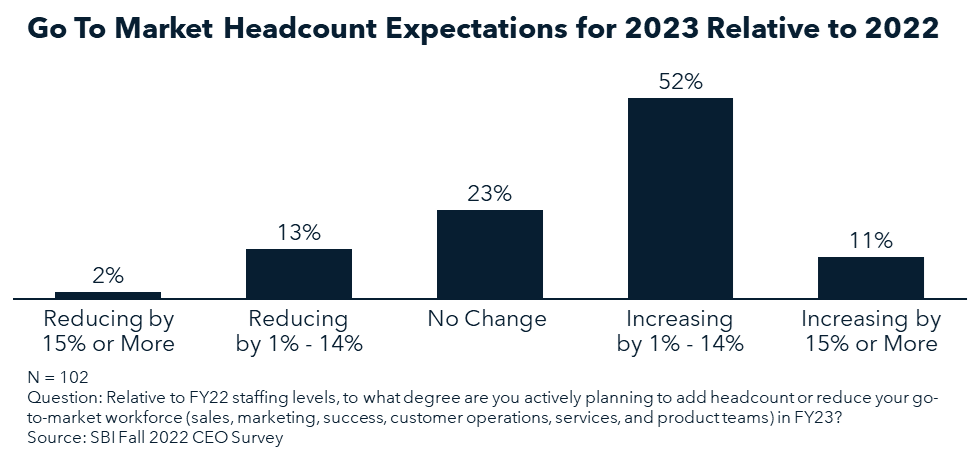
Leaders’ calculation to hire less than what’s needed to cover current needs is likely driven by the tight labor market and a risk-averse hesitation to new headcount additions, as well as uncertainty around whether new hires will boost the topline enough to justify carrying their additional costs. Two implications come from this decision. First, there is significant risk that new hires who do come on will be spread thinner than their predecessors unless leaders redesign territories to increase efficiency. Second, productivity gains will be necessary to sustain the status quo, with further increases required to realize growth.
Leaders can boost seller productivity to more efficiently cover new and expanded territory by refreshing buyer segmentation as well as territory assignments, driving efforts to opportunities that are qualified and have high propensity to buy. This refresh, which should be part of a standard operating cadence, can be augmented by adjusting rules of engagement to push targeted account-based marketing motions, aligning customer-centric messaging and product offerings with customer needs.
In addition to keeping new sellers focused on the best opportunities, arming them with a conclusive sales playbook and enablement curriculum will enhance their productivity. These tools can take the pressure off sellers to remember disparate information sources and word-of-mouth methods by giving a single source of information that leverages a company standard. This makes them both more internally efficient and more efficient in their customer and prospect interactions.
Finally, strategically engaging with partners is another avenue to maintain a presence in non-core theaters that are hard to cover directly. In a time of uncertainty, leaders must rationalize the cost to play versus the benefit from competing in non-core markets. Channel engagement can extend reach with minimal headcount requirement and reduced risk. Successful partner management programs contain three common elements: the ability to recruit, onboard, and enable channel partners; best-in-class partner experience programs; and collaborative planning and pursuit to maximize both potential and value realization.
Shortcomings with onboarding new Sales hires is a significant risk
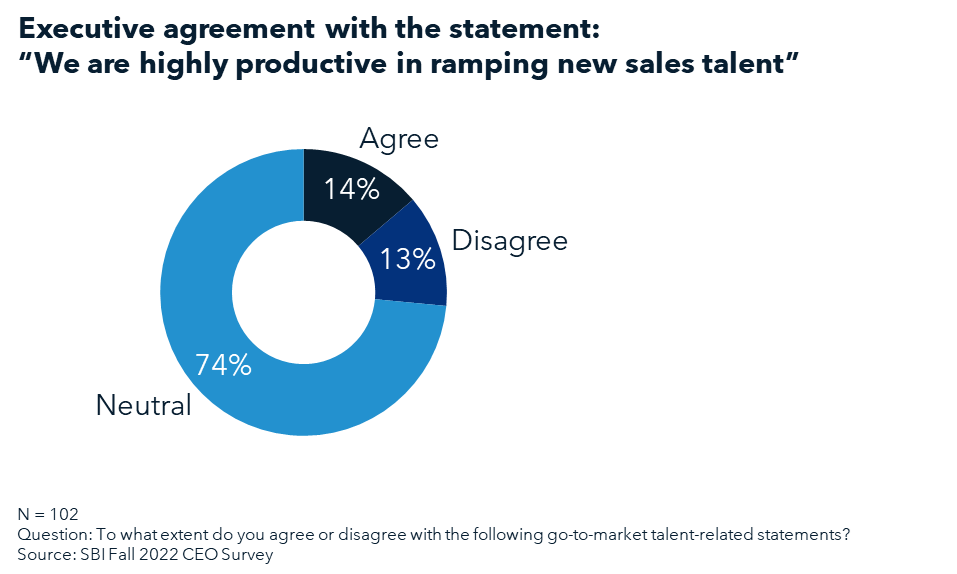
For new hires to realize their full potential and become fruitful teammates, organizations must proactively onboard them into the organization. While nearly one-third of leaders worry that their inability to hire will harm 2023 growth, only 14% have faith in their organization’s ability to successfully onboard new hires. This goes directly against the growth imperative of minimizing new hire ramp time to drive value for the company through deal wins.
Inability to successfully onboard could look different across organizations and industries, from asymmetric selling motions and abilities to varying degrees of administrative follow-through to differing attention given to CRM hygiene. These in turn cause frustration among the team and reduce the likelihood of hitting attainment goals. Pushing against these historical failures requires an operating system-level rethinking of how a Sales organization brings new hires into the fold.
Hiring high quality candidates will help with onboarding as they already have the requisite skills and knowledge to succeed. It is important to remember, though, that each new hire will come with their own skillset and sales plays from their prior experience, creating risk of confusion and being out of step with their new colleagues. Time to value is of the essence in down markets, so promoting a standard system across all sellers within the organization is imperative.
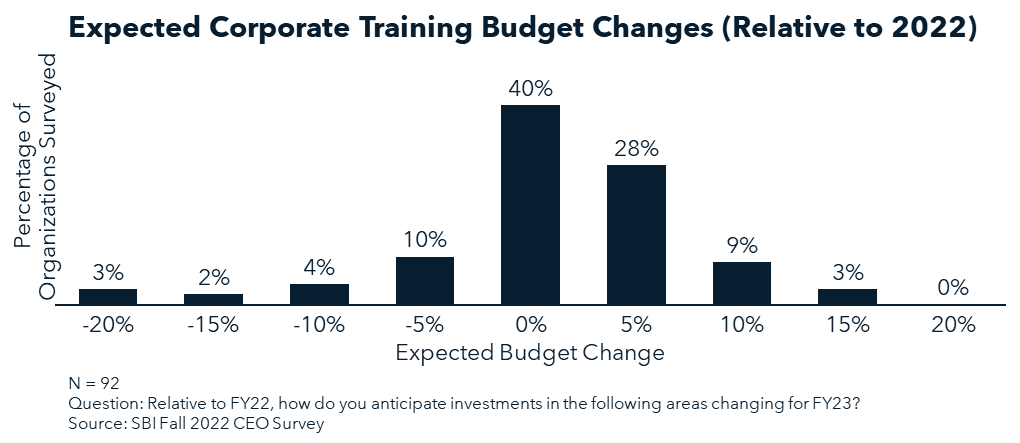
Implementing a comprehensive onboarding program is rarely a high priority for go-to-market leadership teams. Our data indicates that 40% of leaders do not foresee a change in their corporate training budgets in 2023 and that a further 20% will be reducing training budgets ahead of expected market turmoil. Of the 40% that do expect increases in training budgets in 2023, most will be moderate, a 10% increase or less.
Aligning onboarding learning objectives with clear, specific metrics that are tied to business outcomes, rather than vague progress reports without context to the business, can anchor an onboarding program in reality and demonstrate the value of the program. SBI’s benchmark for a best-in-class onboarding program that can drive new seller value is 90 days plus the average sales cycle within the organization. Four components are essential to rapidly ramp new hires to productivity:
- Assessing competencies and proficiencies to determine where focus is needed
- Creating 30/60/90-day onboarding plans that anchor outcomes at each interval to core competencies of the organization
- Scheduling weekly onboarding activities that drive toward achieving competency certifications that validate learning
- Implementing a “Learn-watch-do-reinforce” framework that allows new hires to gather feedback and coaching throughout the process
Burnout among employees is a threat to productivity, but leaders aren’t clear on the drivers
As companies bring in new sellers and expand their territory assignments, the risk of burnout grows. Unfortunately, leaders struggle to identify the root causes of burnout, creating a liability for the business. While identifying the root causes of burnout is important and situation-specific, our data indicates that leaders’ attitudes toward new hire territory loads and inability to successfully onboard new talent may be part of the issue.
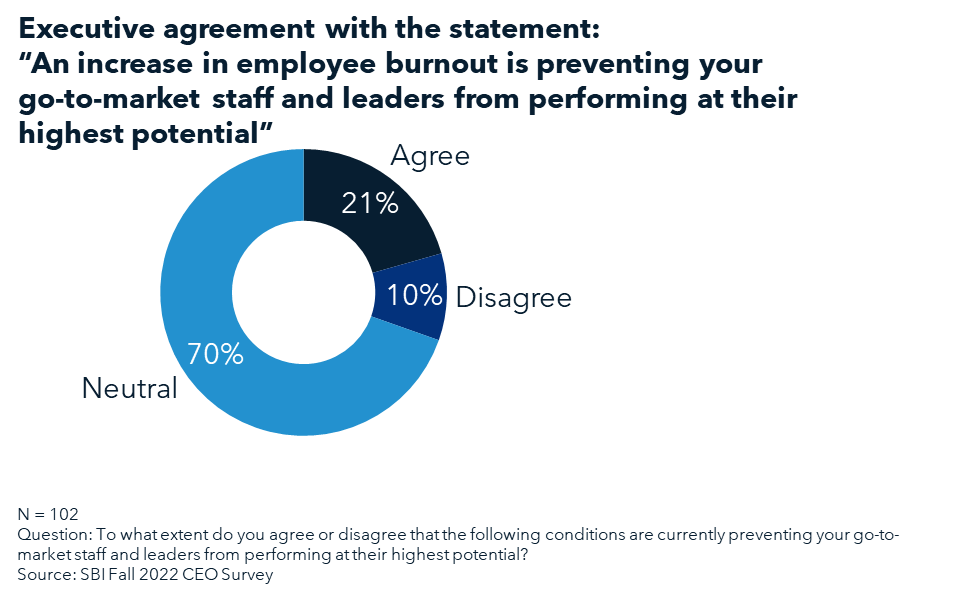
Our data indicate that 21% of CEOs saw an increase in burnout among their staffs in 2022. While not a high proportion, given the levels of open territory, customer uncertainty, and internal pressures to maintain growth and keep costs low, it raises concern that there is more burnout that leaders aren’t seeing, or that the proportion is growing by the day.
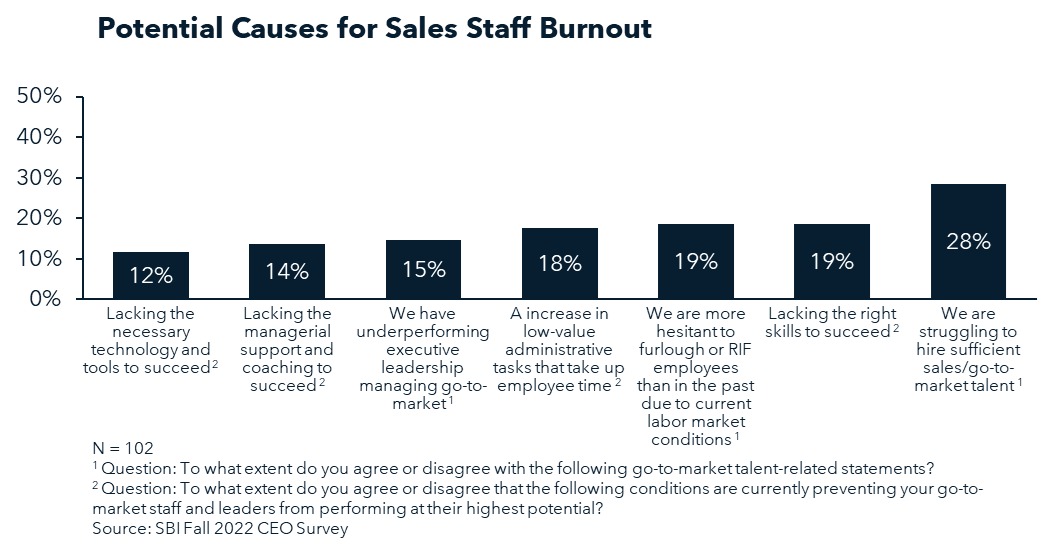
The bigger concern, though, is that there is little clarity on the ultimate source of burnout. Only 18% of leaders see their staff being overburdened by arduous administrative tasks, and only 14% believe their staff lack adequate support and coaching from their managerial tiers. This leads to a question: if not wasted time and not lack of support, what is the ultimate reason for one in five CEOs seeing greater levels of Sales staff burnout?
One solution is to equip managers to recognize burnout and empower them to intervene before the issue becomes a problem. SBI recommends conducting a talent assessment to gather relevant, timely data. This talent assessment should look for alignment needs – whether the right people are in the right roles – and coaching gaps. Couple this assessment with an enablement program for managers to promote upskilling and cultural development within their teams.
PREVENT THE “TALENT ROLLERCOASTER”
Go-to-market leaders’ ability to drive sales productivity will be essential in 2023. Given the appetite for headcount expansion, despite expectations of a down market, executives are signaling the need to spend to maintain the status quo. This adds additional pressure to ensure those resources are well spent, retaining employees and enabling them to be effective more quickly and more broadly than has been required historically. Organizations that proactively address their talent hurdles can emerge from an uncertain market with a stronger and highly productive Sales force.